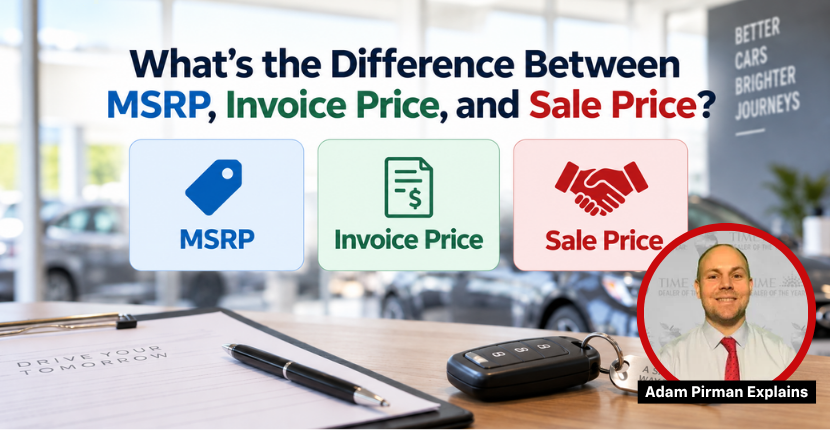
What’s the Difference Between MSRP, Invoice Price, and Sale Price?
By Adam Pirman, Sales Manager at Apple Chevrolet
One of the things that can make shopping for a new vehicle confusing is the number of different prices you may see.
MSRP. Invoice price. Dealer discount. Rebates. Sale price. Out-the-door price.
What do all these numbers actually mean?
After more than 18 years in the automotive industry, I can tell you this is something customers ask about all the time at our Tinley Park Chevrolet dealership. And I understand why. If you’re spending $30,000, $50,000, or even more on a vehicle, you should understand exactly what the numbers mean.
So, let’s break it down.
What Is MSRP?
MSRP stands for Manufacturer’s Suggested Retail Price.
This is the retail price suggested by the vehicle manufacturer. On a new Chevrolet, you’ll see pricing information on the vehicle’s factory window sticker, along with the vehicle’s standard equipment, factory-installed options, and other information.
The most important word in MSRP is “suggested.”
MSRP isn’t necessarily what you’re going to pay for the vehicle.
Depending on the vehicle, market conditions, inventory, manufacturer programs, and dealership pricing, the actual selling price can be higher or lower than MSRP.
Think of MSRP as the starting reference point for the vehicle.
What Is Invoice Price?
This is where things get a little more interesting.
The invoice price is the amount shown on the manufacturer’s invoice to the dealership for the vehicle.
Customers sometimes hear the term “invoice” and assume that number represents exactly what the dealership ultimately has invested in the vehicle.
It isn’t always that simple.
Manufacturers can have various programs, incentives, allowances, or other adjustments that affect the economics of a vehicle beyond the number printed on the invoice.
So while invoice price is a real number and an important part of vehicle pricing, it shouldn’t automatically be interpreted as the dealership’s final or true cost.
That’s an important distinction.
Does Buying at Invoice Mean the Dealership Isn’t Making Money?
Not necessarily.
This is another misconception I hear from time to time.
Someone may research a vehicle online, find an estimated invoice price, and assume anything above that number represents dealership profit.
The actual economics of selling a new vehicle are considerably more complicated than simply:
Sale Price – Invoice Price = Dealer Profit
There can be manufacturer programs and other factors involved, and the dealership itself has expenses associated with operating the business, maintaining inventory, preparing vehicles, employing staff, and providing facilities and services.
That’s why I don’t think focusing exclusively on invoice price is the best way for a customer to determine whether they’re receiving a good deal.
The more useful question is:
What is this vehicle actually selling for, and does the overall transaction make sense for me?
What Is the Sale Price?
The sale price is the price the dealership agrees to sell the vehicle for, subject to the terms and qualifications that apply to the transaction.
For example, let’s use simple numbers.
A vehicle might have:
MSRP: $50,000
Dealer Discount: $2,000
That could bring the vehicle to a:
Sale Price: $48,000
Depending on the vehicle and the customer, there may also be manufacturer incentives or rebates available.
That’s where pricing can become more complicated because not every incentive necessarily applies to every customer.
How Do Chevrolet Rebates and Incentives Affect the Price?
Chevrolet may offer different programs throughout the year.
Depending on the vehicle and current programs, these might include customer cash, special financing, lease programs, or offers available to qualifying groups.
Some incentives may be available to most customers, while others have specific eligibility requirements.
There can also be situations where one offer cannot be combined with another.
For example, a customer may have a choice between a cash incentive and a special financing rate.
That means the lowest advertised price isn’t always automatically the best overall financial choice.
Sometimes giving up a rebate in exchange for a significantly lower interest rate can save more money over the life of the loan.
This is why we look at the entire transaction with the customer rather than just one advertised number.
Why Can Two Customers Pay Different Prices for the Same Vehicle?
This is another great question.
Two people can purchase identical vehicles and end up with different transactions.
One customer may qualify for a particular manufacturer incentive that another customer doesn’t.
One may choose a special financing program instead of a rebate.
One may lease while the other finances.
Their credit profiles, trade situations, available programs, and even the timing of their purchases can be different.
That doesn’t necessarily mean one customer received a “good deal” and the other received a “bad deal.”
It means their individual transactions were different.
Is the Sale Price the Same as the Out-the-Door Price?
No, and this is probably the most important distinction for customers to understand.
The sale price is the agreed-upon price of the vehicle.
The out-the-door price reflects the amount required to complete the purchase after applicable taxes, title, registration, and any other applicable items are accounted for.
For example:
Vehicle Sale Price: $48,000
Then the transaction may include applicable:
- Sales tax
- Title and registration
- Applicable fees
- Optional products selected by the customer
Those items affect the final amount due.
That’s why, when comparing offers from different dealerships, I recommend making sure you’re comparing the same numbers.
A $500 difference in an advertised vehicle price doesn’t necessarily mean you’re saving $500 if the rest of the transaction is structured differently.
Don’t Confuse the Vehicle Price With the Monthly Payment
This is another area where customers can get themselves into trouble.
A salesperson can make a monthly payment lower simply by extending the loan term or changing the amount of money down.
That doesn’t mean the vehicle became less expensive.
If you’re financing, I recommend understanding both:
What am I paying for the vehicle?
and
What will the financing cost me?
Those are separate conversations.
A comfortable monthly payment is important, but so is understanding the total transaction.
My Advice: Look at the Entire Deal
If you’re shopping for a vehicle, don’t become overly focused on one number.
MSRP is useful.
Invoice price is useful.
Sale price is extremely important.
But none of them tells the entire story by itself.
I recommend looking at:
- MSRP
- Actual sale price
- Manufacturer incentives you qualify for
- Trade-in value
- Trade payoff, if applicable
- Interest rate
- Amount financed
- Loan term
- Money down
- Final out-the-door amount
Then ask yourself:
Does the entire transaction make sense for me?
After more than 18 years doing this, I’ve learned that the best customers aren’t necessarily the ones who know every automotive pricing term.
They’re the ones who ask questions until they understand exactly what they’re agreeing to.
And that’s something I encourage every customer to do.
Have Questions? I’m Here to Help.
Every customer’s situation is unique.
Whether you are deciding between leasing and financing, trying to understand your trade value, researching your next Chevrolet, or simply wondering if now is the right time to buy, my team and I are always happy to have an honest conversation.
At Apple Chevrolet, our goal is not just to sell vehicles. Our goal is to help customers make informed decisions they feel confident about at our Tinley Park Chevy dealership.
If you have questions, feel free to reach out directly:
Adam Pirman
Sales Manager
Apple Chevrolet
708-429-3000
apriman@applechevy.com
Or stop by and visit us:
Apple Chevrolet
8585 W 159th St
Tinley Park, IL 60487
I look forward to helping you with your next Chevrolet experience.